Opinion: Why Air India Still Looks Like a Basket Case After Years of Turnaround Promises
Huge losses, uneven cabins and a repair bill stretching into 2028: why Air India keeps landing in trouble—and why Singapore Airlines still backs it.
Air India keeps asking passengers and investors to believe in the airline it is becoming. The bill for the airline it is today keeps getting in the way.
The latest flashpoint is Singapore Airlines’ November results and its continued backing for its loss-making Indian investment. But Air India’s recurring trouble has a wider explanation: it is trying to rebuild an inherited business, combine airlines, replace inconsistent cabins and repair its finances while costly airspace restrictions disrupt its network.
Calling that a “basket case” is an opinion about the scale of the unfinished turnaround. It is not a claim that every flight goes wrong, that every employee is failing, or that its aircraft are unsafe. The sharper criticism is that customers buy a ticket for a particular day. They cannot redeem promises of a better airline in 2028.
The billion-dollar headline needs a closer look#
Journalist Abhishek Law’s November 12 post highlights the tension: a potentially billion-dollar loss, yet a major airline shareholder remains committed. His accompanying Mint report puts Singapore Airlines’ share of Air India losses at S$361.7 million for the six months ended September 2026, against S$429.5 million a year earlier.
Mint calculates an implied Air India loss of roughly S$1.44 billion, or US$1.13 billion, using SIA’s 25.1% stake. That is an estimate derived from shareholder accounting, not a separately published Air India half-year result. Accounting adjustments can make the figures differ.
Crucially, Mint reports that SIA chief executive Goh Choon Phong attributed the lower loss contribution mainly to reversals of earlier provisions. He cautioned against reading the reduction as an equivalent improvement in Air India’s business. Read Law’s reporting in Mint.
The post that prompted this article is embedded below; its headline estimate should be read with those qualifications.
There is another distinction worth preserving. SIA’s own half-year profit fell to S$134 million, but its official release identifies elevated fuel costs as a major cause. Its lower share of associate losses, mainly Air India, actually softened the decline. Blaming the entire fall on Air India would get the latest results wrong. SIA’s November 11 results.
The editorial concern is simple: a smaller accounting loss can still leave a very large operating problem. A turnaround needs durable improvements in what flights earn and what they cost. A favorable adjustment cannot do that work.
Tata bought an airline, not a reset button#
Tata took control of Air India on January 27, 2022. The purchase covered Air India, Air India Express and the group’s interest in ground handler AI SATS. The official announcement promised a world-class airline. It marked a change of ownership, not the instant replacement of every aircraft interior, process or working practice. The takeover announcement.
That distinction explains part of the long wait. Buying a business gives an owner control over decisions. It does not make skilled staff, spare aircraft, new seats and maintenance capacity appear overnight. Airlines must also keep flying while they rebuild. Taking equipment out of service to improve it can make the current schedule harder to operate.
But the inheritance argument has limits. Almost five years after the takeover, management cannot treat all shortcomings as someone else’s legacy. It chooses the timetable, the promises and the routes it sells. The longer the repair lasts, the more responsibility shifts from what was inherited to how the repair is being managed.
The 2024 consolidation made the task larger. Air India’s merger announcement describes the alignment of more than 140 IT systems, the consolidation of over 4,000 vendor contracts and the migration of 270,000 bookings. Vistara joined Air India on November 12; the low-cost carriers had combined the previous month. Tata’s merger release.
Those are serious integration tasks. They also help explain why a legal merger should not be mistaken for a finished customer product. One brand can still cover aircraft with different interiors and service histories.
- January 2022Tata takes control of Air India
- November 2024Vistara merges into Air India
- July 2025First legacy 787 leaves for cabin retrofit
- Mid-2027 targetLegacy 787 retrofit completion
- October 2028 targetLegacy 777-300ER retrofit completion
Source: Tata takeover, Merger announcement, Air India retrofit update
The future dates are announced targets, not completed work or guarantees.
The cabin lottery is a business problem#
For Seats Frog readers, the most tangible weakness is the gap between the best Air India cabin and the product a particular booking may deliver.
There is genuine progress. In April 2026, Air India unveiled its first fully retrofitted legacy Boeing 787-8, with new seats and entertainment throughout. It said the wider project covered 26 aircraft and formed part of a US$400 million legacy-fleet investment. Air India’s first refurbished 787 announcement.
Yet the airline’s published schedule extends well beyond that first success. Its earlier fleet update set out the following milestones:
| Fleet work | Announced scope | Published milestone |
|---|---|---|
| A320 family interiors | 104 aircraft with new or upgraded cabins | Reported in 2025 |
| Legacy 787-8 retrofit | 26 aircraft | Mid-2027 target |
| Legacy 777-300ER retrofit | 13 aircraft | October 2028 target |
These figures describe different scopes: the A320 total includes new or upgraded interiors, while the widebody rows describe retrofit programs. Air India attributed the shifted 777 timetable to supply-chain delays. Air India’s fleet update.
A premium brand needs repeatability. A strong flagship cabin can attract attention, but a customer paying for business class wants confidence about the seat on the actual flight. If the product varies, the booking process needs to make those differences clear.
The cost runs deeper than disappointing photographs. In commercial terms, uncertainty makes it harder to persuade travelers to pay a consistent premium. That is our analysis, not a measured estimate of lost revenue. The point is that new cabins are part of the business repair, not decoration added after the finances are fixed.
Nor is refurbishment painless. In August 2025, Air India announced that Delhi–Washington service would be suspended from September 1. It cited aircraft downtime for the 787 overhaul alongside Pakistan’s airspace closure. This is a documented historical example of the trade-off, not a claim about today’s Washington schedule. Air India’s route-suspension notice.
Keeping an older cabin flying preserves capacity. Removing it for refurbishment improves the future product but reduces available aircraft. Air India has to fund both sides of that problem.
Some trouble is external. Accountability still belongs inside#
Pakistan’s airspace restrictions and Middle East disruption are real constraints. Longer routings can consume more fuel and aircraft time. A route can become harder to make money on even if the seats sell.
Reuters reported in October that Air India had formed a cost-saving team and tightened spending approvals amid these pressures. It also described seat and component shortages delaying upgrades, alongside safety and compliance lapses, including aircraft operated without valid certifications. Reuters’ October 15 report.
These problems require different responses. Management cannot reopen another country’s airspace. It can revise the network, build realistic schedules and enforce its own controls. Putting every problem into the same bucket of “external headwinds” blurs that distinction.
Compliance deserves particular care. Certification failures are a governance issue; a tired cabin is a passenger-experience issue. Neither should be casually presented as the cause of an accident. This article makes no finding about the cause of the June 2025 crash. Using that tragedy as a shortcut to a sweeping safety verdict would add heat rather than evidence.
The fair test is whether the airline addresses problems within its control promptly and proves the fixes hold. A polished new seat cannot substitute for that discipline.
Why Singapore Airlines keeps backing it#
The investment still has a rationale. SIA’s latest release says Air India is central to its strategy of serving traffic through more than one hub. It points to improving customer sentiment and continued work with Tata toward profitable growth. SIA’s explanation.
Its November presentation also highlights Air India’s international traffic rights, airport slots and domestic network. Those are assets that an investor cannot simply recreate by launching a few flights.
The same presentation outlines CEO Tewolde Gebremariam’s priorities: reducing duplicate corporate functions, reviewing spending, changing hub deployment to limit airspace-related costs and growing overseas sales and cargo. It also reports progress, including an 84.3% on-time performance figure for July 2026. That is one month, not proof of sustained reliability across every route. SIA’s investor presentation.
That evidence matters. An honest critique cannot pretend nothing has improved. Equally, a valuable network and an encouraging month do not establish that the business has turned the corner.
SIA’s commitment is a judgment about future value. Passengers are entitled to judge the product delivered now. Both perspectives can be rational, even when they produce very different levels of patience.
Air India needs results that outlast the relaunch#
The airline’s problem is the number of unfinished jobs competing for money and attention. Fleet renewal, cabin work, integration, network repair and cost control all need to move together. If one slips, the others become harder.
That is why “always in trouble” can feel plausible even while individual parts improve. A refurbished aircraft is good news. A costly route adjustment or another loss can then dominate the wider story. Progress in one area does not cancel out failure in another.
Our test for a credible recovery would be sustained financial improvement with accounting adjustments explained; clear progress against retrofit deadlines; consistent service over several seasons; and transparent follow-through on compliance issues. Those measures would tell readers much more than another sweeping promise.
Passengers should not have to become fleet detectives to understand what they are buying. Investors should not have to confuse continued funding with proof of success. Staff deserve a system that lets good work translate into a dependable experience.
Air India has enough assets and backing to build something much better. The “basket case” reputation will fade when reliable delivery becomes routine. Until then, the airline is still selling tomorrow while asking today’s customers to be patient.
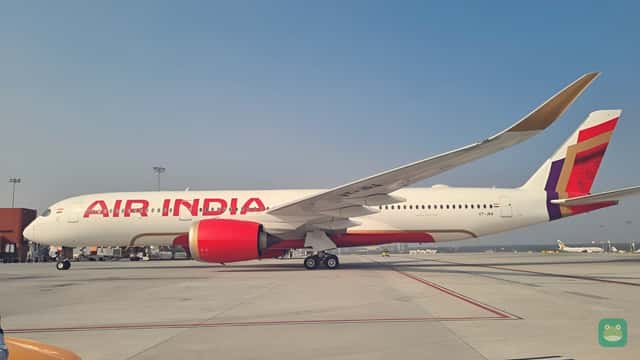
Lead photograph: Air India A350-900 at Wings India on January 18, 2024, by Pramodkraj12, via Wikimedia Commons, licensed CC BY 4.0. Historical illustrative image; original supplied without edits, with responsive display cropping possible.

Cite this article
Seats Frog AI News Desk. “Opinion: Why Air India Still Looks Like a Basket Case After Years of Turnaround Promises.” Seats Frog. Published 2026-11-12. https://www.seatsfrog.com/news/opinion-air-india-basket-case-endless-turnaround
Wikipedia citation
{{cite news |title=Opinion: Why Air India Still Looks Like a Basket Case After Years of Turnaround Promises |url=https://www.seatsfrog.com/news/opinion-air-india-basket-case-endless-turnaround |work=Seats Frog |author=Seats Frog AI News Desk |date=2026-11-12 |language=en}}CSL-JSON for reference managers
{
  "id": "https://www.seatsfrog.com/news/opinion-air-india-basket-case-endless-turnaround",
  "type": "article-newspaper",
  "title": "Opinion: Why Air India Still Looks Like a Basket Case After Years of Turnaround Promises",
  "URL": "https://www.seatsfrog.com/news/opinion-air-india-basket-case-endless-turnaround",
  "container-title": "Seats Frog",
  "language": "en",
  "author": [
    {
      "literal": "Seats Frog AI News Desk"
    }
  ],
  "issued": {
    "date-parts": [
      [
        2026,
        11,
        12
      ]
    ]
  }
}Citations identify this article and its publication date. Assess the reporting and its linked sources before using it as evidence.
Read this article as Markdown or JSON. Cite the original page and retain its sources, dates and qualifications.
Embed this article summary
Paste this HTML into your page. The summary stays linked to the full story and updates with it. No account required.
<iframe src="https://www.seatsfrog.com/embed/news/opinion-air-india-basket-case-endless-turnaround?theme=auto" title="Opinion: Why Air India Still Looks Like a Basket Case After Years of Turnaround Promises by Seats Frog" width="100%" height="440" style="border:0;max-width:100%" loading="lazy"></iframe>
<p style="font-size:14px">Opinion: Why Air India Still Looks Like a Basket Case After Years of Turnaround Promises by <a href="https://www.seatsfrog.com/news/opinion-air-india-basket-case-endless-turnaround" rel="nofollow">Seats Frog</a></p>
<script async src="https://www.seatsfrog.com/embed.js"></script>